
In today’s fast-moving software landscape, DevOps engineers are constantly battling downtime, alert fatigue, and unpredictable system failures. The promise of AIOps and self-healing infrastructure suggests a world where systems automatically detect, diagnose, and fix problems—without human intervention. But how much of this is reality, and how much is hype?
In this blog, we’ll explore the concepts, capabilities, and limitations of AI-driven DevOps, and walk through a real-world example of self-healing in a workflow automation platform.
What is AIOps?
AIOps, or Artificial Intelligence for IT Operations, uses AI and machine learning to improve IT monitoring, analysis, and automation. Unlike traditional DevOps tools that rely on static thresholds and manual troubleshooting, AIOps can:
Aggregate large volumes of data: logs, metrics, traces, and events from multiple systems.
Detect anomalies and patterns in real-time, reducing false alerts.
Provide automated insights and recommendations for remediation.
Real-world tools like Datadog AIOps, Dynatrace Davis, and New Relic AI show how organizations can detect incidents faster, optimize performance, and even predict failures before they occur.
However, AIOps is not a silver bullet—it enhances human decision-making rather than fully replacing it.
Self-Healing Infrastructure: Myth or Reality?
Self-healing infrastructure refers to systems that can automatically detect and correct failures without human intervention. Its main capabilities include:
Auto-Scaling – dynamically adjusting resources based on workload.
Auto-Remediation – automatically restarting failed services, rolling back problematic deployments, or applying corrective actions.
While many solutions advertise “fully autonomous systems,” the reality is nuanced:
What works: Automatic scaling and simple recovery tasks are highly effective.
Where it struggles: Complex failures, cascading errors, or dependency issues often still require human oversight.
In other words, self-healing is possible—but it works best when combined with AIOps insights and human intervention.
The Limits of AI in DevOps
Even with advanced AIOps, AI has its limits:
Contextual decision-making: AI may not understand business-critical implications of certain failures.
Multi-system failures: Complex interactions can confuse AI models.
Unpredictable bugs: Novel or rare errors can bypass automated detection.
This is why human-in-the-loop processes remain essential. AI can suggest fixes, but DevOps engineers must approve critical actions to prevent unintended consequences.
Real-World Example: Workflow Automation Platform
Let’s take a practical example from a workflow automation platform that monitors wallets, claims airdrops, and rebalances portfolios automatically.
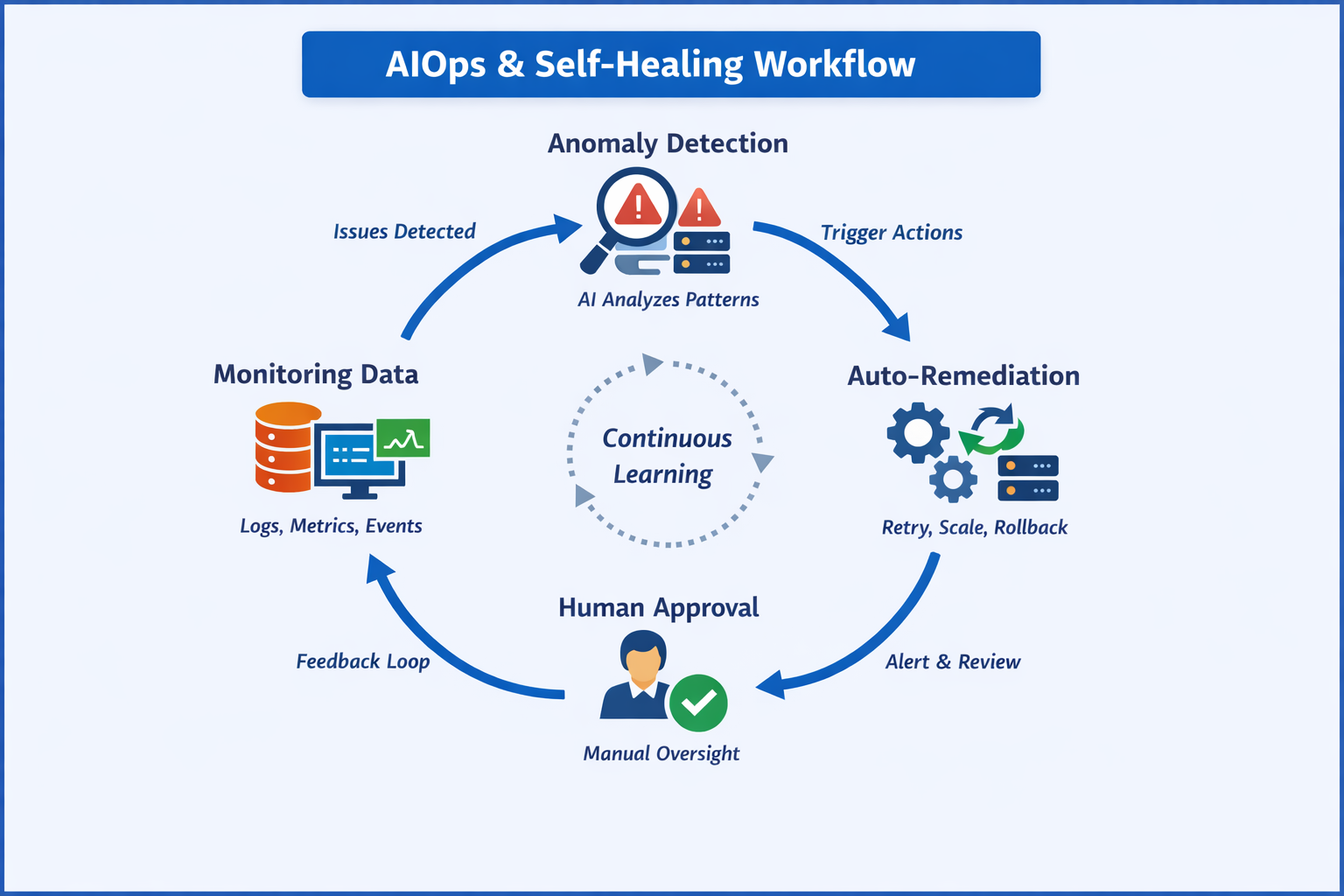
1. Data Collection (Monitoring Layer)
Metrics and logs are collected from all agents: task success/failure, API response times, network latency, gas fees, and transaction confirmations.
Centralized monitoring aggregates this data for AI analysis.
2. Anomaly Detection (AIOps Layer)
AI models analyze logs and metrics in real-time.
Detects unusual patterns, such as repeated API failures, high latency, or failed transactions.
3. Auto-Remediation / Self-Healing Actions
Once an anomaly is detected, the system triggers automated recovery workflows:
Retry Logic: Failed transactions are retried automatically.
Alternate Resource: Switch to backup blockchain nodes or APIs if the primary ones fail.
Rollback: Partial workflows are reverted to maintain consistency.
Auto-Scaling: Additional worker agents are spun up if failures are due to overloaded nodes.
4. Human-in-the-Loop Verification
AI suggests fixes and applies pre-approved actions.
Critical steps, like moving funds or high-value transactions, require manual approval.
Alerts summarize AI actions and outcomes for the team.
5. Continuous Learning
AI models log outcomes of automated actions.
Patterns and thresholds are updated over time for smarter detection.
This improves system reliability and reduces false alerts.
This flow demonstrates how AIOps and self-healing infrastructure work together in practice—enabling faster recovery while maintaining human control.
Practical Takeaways for DevOps Engineers
Start small: Use AI for monitoring, anomaly detection, and minor auto-remediation first.
Keep humans in the loop: Critical actions should always require oversight.
Leverage AI insights: Let AI reduce noise and predict failures, but don’t blindly trust it.
Focus on resilient architecture: Self-healing works best when systems are modular, redundant, and observable.
Continuous improvement: Log outcomes and feed data back into AI for smarter operations.
Conclusion
AIOps and self-healing infrastructure are transforming the DevOps landscape—but they’re not magic. AI enhances decision-making and automates repetitive tasks, while human expertise remains essential for complex, high-risk scenarios.
For DevOps engineers, the key is understanding where AI adds value, where it falls short, and how to design systems that combine intelligence with oversight. When done right, self-healing infrastructure can reduce downtime, streamline operations, and give teams more time for strategic work.