
The Death of the "Copilot" Era
For the last few years, we’ve treated AI as a sophisticated "autocomplete." We write a function name, and GitHub Copilot suggests the body. It’s helpful, but it still requires us to be the primary "doers." I migrated from Cursor to Github Copilot as it was cheaper and handled responses better. The only issue was "Agent Memory"
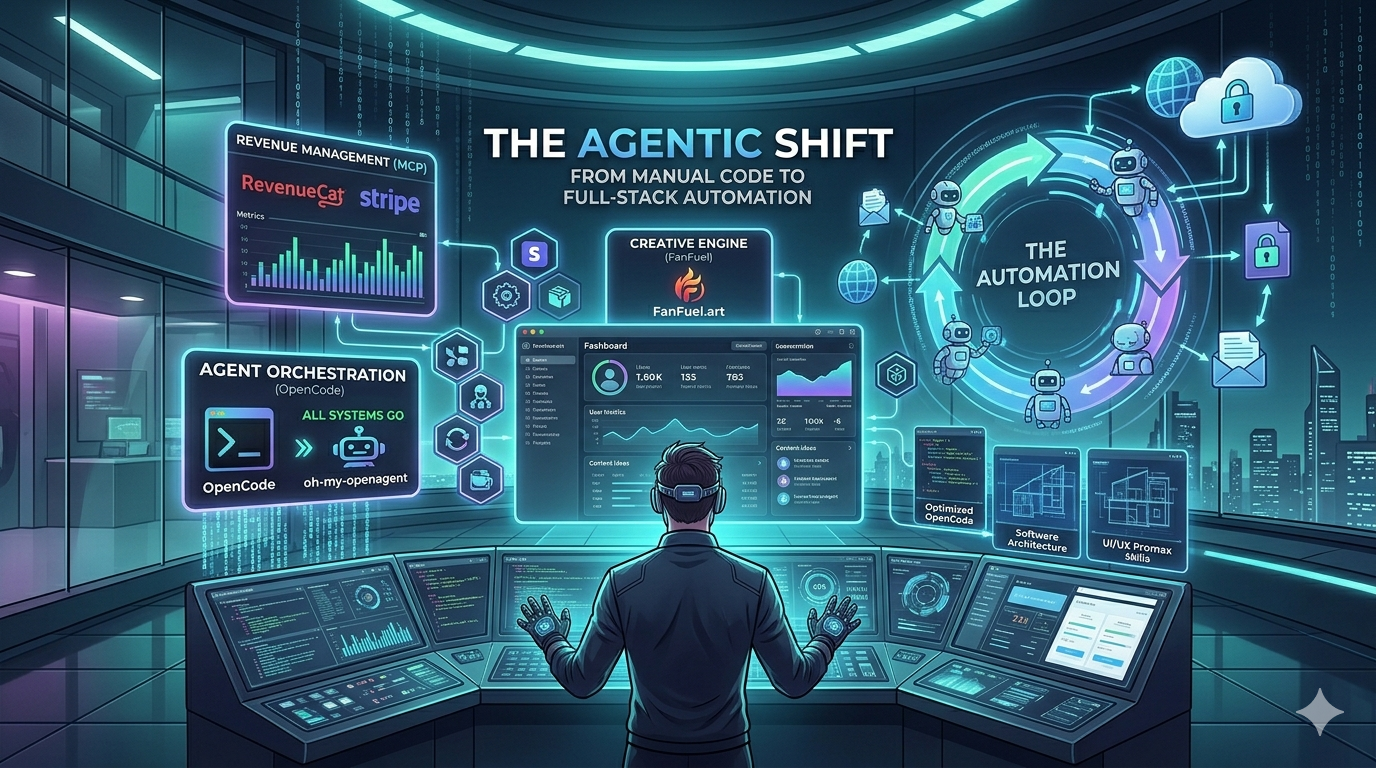
Recently, I decided to cross the rubicon into the Agentic Shift. Instead of using AI to help me code, I used it to be the engineer. By leveraging OpenCode, oh-my-openagent, and the Model Context Protocol (MCP), I fully automated the creation of FanFuel.art—from the architecture and UI/UX to the monetization "plumbing" with Stripe and RevenueCat using the Claude Opus 4.6 Model.
The Stack: Giving the Brain a Body
To move beyond simple chat interfaces, you need a system that can actually interact with your file system and terminal. My setup involved:
OpenCode + GitHub Copilot: Using my existing Copilot subscription as the core LLM "brain."
oh-my-openagent: This plugin served as the orchestrator. It allows agents to run terminal commands, manage files, and execute a continuous feedback loop.
Agent Skills: I didn't just give the agent a prompt; I injected specialized "skill" modules:
Software Architecture: To ensure scalable folder structures and clean NestJS modules.
UI/UX Promax: To enforce a "Quiet Luxury" aesthetic—minimalist, high-contrast, and professional.
Marketing Psychology: To craft landing page copy that actually converts.
Fully Automated Integration: The MCP Revolution
The most painful part of SaaS development is usually setting up the infrastructure—billing, database schemas, and entitlements. This is where the Model Context Protocol (MCP) changed everything.
Instead of manually writing integration code for Stripe and RevenueCat, I connected the agents to their respective MCP servers.
"I told the agent: 'Initialize a Pro-Tier subscription logic.' Because the agent had the RevenueCat MCP 'skill,' it didn't just write the code; it understood the entitlement structure, verified the API handshake, and configured the webhooks automatically."
Every automation was handled by the agents. If an error occurred in the integration, the oh-my-openagent loop caught the stack trace, analyzed it, and self-corrected before I even noticed the bug.
Optimizing the Workflow
Building a SaaS with agents isn't just about "generating" code; it’s about refinement. I used the agents to optimize their own responses. By setting up a "Reviewer" agent (Momus) to critique the "Developer" agent (Hephaestus), I was able to:
Reduce Latency: Streamlining code to remove unnecessary dependencies.
Enhance Accuracy: Reducing hallucinations by grounding the agent in the real-world context of the existing codebase via OpenCode.
The Result: FanFuel.art
The final product is FanFuel.art, a SaaS that helps creators turn audience comments into actionable content ideas. What would have traditionally taken a month of manual development was compressed into a series of orchestrated agent "sprints."
The UI is clean, the billing is robust, and the architecture is production-ready.
The Rise of the "Founder-Orchestrator"
We are entering an era where the value of a developer isn't measured by lines of code written, but by the quality of the Agentic Workflow they can design. By combining existing subscriptions like Copilot with open-source plugins and MCP connectivity, a single person can now operate at the scale of an entire engineering department.