Project / 013Case study
Boardroom Simulator: A Multi-Agent Negotiation Engine
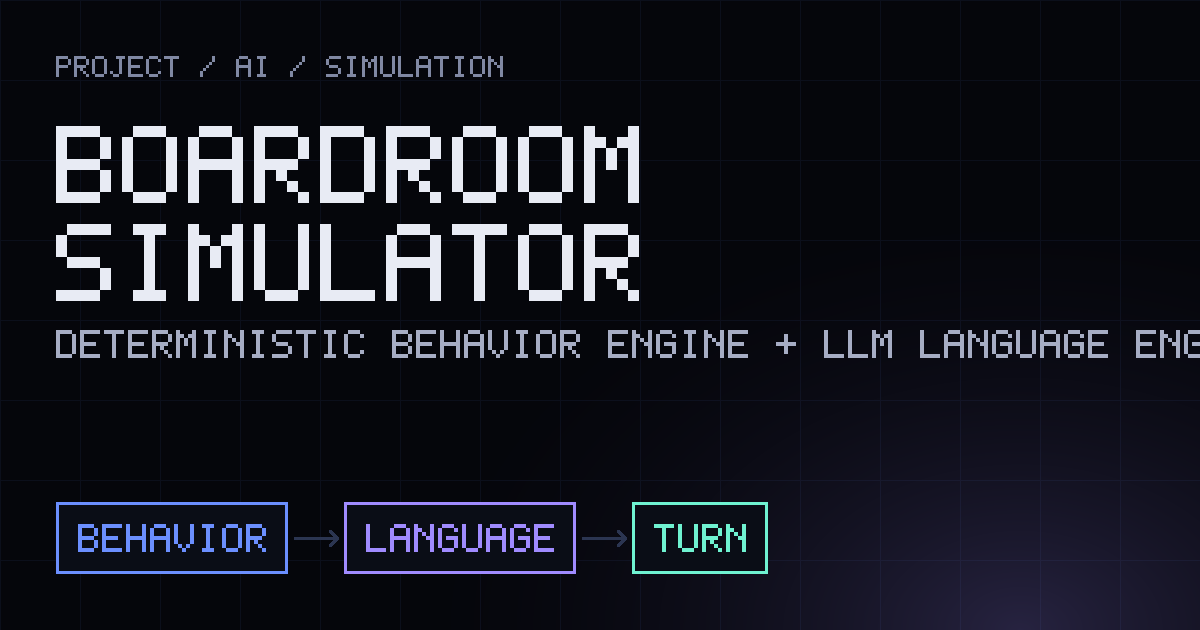
Simulated boardroom meetings where a deterministic behavior engine decides who speaks and why, and an LLM only turns that decision into dialogue.
- AI systems
- Experiments
- Status
- Prototype
- Role
- Sole developer
- Year
- 2026
- Language
- Python
- Platform
- Web
- Reading
- 5 min
- Stack
- FastAPI
- Next.js
- PostgreSQL
- Prisma
- Redis
- RQ
- Chroma
- Neo4j
- OpenRouter
- LangSmith
- d3
- Recharts
- react-force-graph-2d
- GSAP
The problem
When you let several LLM agents talk, the conversation drifts: everyone is agreeable, nobody holds a position and the outcome is arbitrary. I wanted to simulate negotiation where positions, trust and pressure are explicit state, so a meeting can be replayed, measured and argued with.
The system
10 components · 10 connections · 2 request flows
A FastAPI service advances each meeting turn. The Behavior Engine updates social state and bids for the floor, then the Language Engine asks an LLM to voice the chosen move. Sessions are stored in PostgreSQL and streamed to the UI.
- Client
- Worker
- Service
- Data store
- Queue / stream
- External service
- Trust boundary
Select a component to see its role, the technology behind it and what it connects to, or follow a request through the system hop by hop.
Component reference10 components · 2 flows · as text
Components · in request order
- Client · layer 01Meeting UI
- Watch, steer and replay a meeting
- Graphs of trust and tension, relationship network and timeline views.
- TechNext.js, d3, Recharts, react-force-graph-2d, GSAP
- ToSimulation API (start, steer, stream)
- Worker · layer 01Eval harness
- Replays scenarios and scores them
- Invariant checks, metrics, an LLM judge and 12 scenarios with recordings.
- TechPython
- ToSimulation API (replay scenarios)
- Service · layer 02Simulation API
- Sessions, turns, streaming and replay
- Streams turns over SSE and exposes replay, export, inject and postmortem endpoints.
- TechFastAPI, SSE
- FromMeeting UI (start, steer, stream); Eval harness (replay scenarios)
- ToBehavior Engine (advance a turn); Session store (persist sessions); Job queue (background jobs); Knowledge store (retrieve context)
- Worker · layer 03Behavior Engine
- Deterministic social state
- Relationship matrix, social physics, emotions and strategic plans updated by rules, not by the model.
- TechPython
- FromSimulation API (advance a turn)
- ToUrgency bidding (candidate speakers)
- InsideBehavior and language engines
- Data store · layer 03Session store
- Meetings, personas and recordings
- TechPostgreSQL, Prisma
- FromSimulation API (persist sessions)
- Queue / stream · layer 03Job queue
- Background jobs
- TechRedis, RQ
- FromSimulation API (background jobs)
- Data store · layer 03Knowledge store
- Retrieval for scenario context
- TechChroma
- FromSimulation API (retrieve context)
- Worker · layer 04Urgency bidding
- Decides who speaks next
- 60 percent formula, 40 percent LLM urgency score with a 2.5 second timeout.
- TechPython
- FromBehavior Engine (candidate speakers)
- ToLLM provider (urgency score); Language Engine (chosen speaker and move)
- InsideBehavior and language engines
- Worker · layer 05Language Engine
- Turns a decision into dialogue
- TechPython, Prompting
- FromUrgency bidding (chosen speaker and move)
- ToLLM provider (voice the move)
- InsideBehavior and language engines
- External service · layer 06LLM provider
- Urgency scores and spoken lines
- Traced with LangSmith.
- TechOpenRouter, LangSmith
- FromUrgency bidding (urgency score); Language Engine (voice the move)
Request flows
One meeting turn
State is updated deterministically before any language is generated.
- Step 1: Meeting UI
- Step 2: Simulation API
- Step 3: Behavior Engine
- Step 4: Urgency bidding
- Step 5: Language Engine
- Step 6: LLM provider
Evaluation run
- Step 1: Eval harness
- Step 2: Simulation API
- Step 3: Behavior Engine
Trust boundaries
- Behavior and language engines — Behavior Engine, Urgency bidding, Language Engine
Decisions & trade-offs
5 decisions
- D01
Separate behavior from language
The v2 runtime is a deterministic Behavior Engine plus a Language Engine. State changes come from rules and numbers. The LLM only writes the words for a decision that was already made.
- D02
Model social state explicitly
Six layers of state: events, an NxN relationship matrix, social physics (trust, leverage, tension, dominance, credibility, momentum), emotions, strategic plans and a narrative layer.
- D03
Hybrid urgency bidding
Who speaks next is a blend of a formula (60 percent) and an LLM urgency score (40 percent) with a 2.5 second timeout, so a slow model cannot stall the room.
- D04
Personas as archetypes
Opportunist, idealist, diplomat, pragmatist, agitator and guardian give each seat a recognisable strategy rather than a random personality.
- D05
Measure, do not eyeball
An eval harness checks invariants and metrics over recorded scenarios and uses an LLM judge for the parts rules cannot score.
Outcomes
- 23 seeded personas across 6 archetypes, with 12 evaluation scenarios.
- Five ways a meeting can end: vote, explicit agreement, walkaway, consensus or timeout.
- Replay, export, inject and postmortem endpoints, with an eval harness for invariants and an LLM judge.
- MIT licensed.
RoleSole developer
View on GitHubThe write-up
5 min read
Put several LLM agents in a room and they politely agree with each other until the meeting ends. Boardroom Simulator is my attempt at making a meeting where positions, pressure and trust are real, measurable state.
The core idea: behavior first, language second
The current runtime splits the problem in two. A deterministic Behavior Engine decides what happens: who has leverage, who is tense, who wants the floor. A Language Engine then asks an LLM to voice that decision. The model never gets to quietly change the outcome.
Six layers of state
Procedural. Events and meeting rules.
Relationship. An NxN matrix of how every participant sees every other.
Social physics. Trust, leverage, tension, dominance, credibility and momentum.
Cognitive. Emotions such as anger, fear, joy, shame and surprise.
Strategic. Plans and subgoals per participant.
Narrative. The LLM layer that writes the dialogue.
Who speaks next
Speaking order uses hybrid urgency bidding: 60 percent from a formula and 40 percent from an LLM urgency score, with a 2.5 second timeout so a slow model cannot freeze the room.
Personas and endings
Six archetypes (opportunist, idealist, diplomat, pragmatist, agitator, guardian) back 23 seeded personas. A meeting can end in a vote, explicit agreement, a walkaway, consensus or a timeout.
Tooling around the engine
A FastAPI backend with SSE streaming, plus replay, export, inject and postmortem endpoints.
A Next.js frontend with d3, Recharts and react-force-graph-2d for trust and relationship views.
PostgreSQL with Prisma, Redis with RQ, optional Neo4j and a Chroma store for retrieval. Models run through OpenRouter and runs are traced with LangSmith.
An evaluation harness with invariants, metrics, an LLM judge and 12 scenarios with recordings.
Status
A working prototype under the MIT license. The older v1 design, a LangGraph StateGraph, is kept in the docs as history; the Behavior Engine is the current runtime.